12 Quotes on Acceptance and Commitment Therapy
Acceptance and Commitment Therapy Quotes
These are twelve quotes I wrote myself, over years of teaching Acceptance and Commitment Therapy. Below each one I’ve explained the skill it points to, and, because a quote on its own is just a nice sentence, I’ve added the story of what actually happened to me when the idea landed.
Acceptance and Commitment Therapy (ACT) helps to develop a skill called psychological flexibility. It has a genuinely serious evidence base: ACT passed 1,000 randomised controlled trials in December 2022, according to the Association for Contextual Behavioral Science, with new ones appearing at roughly one every three days.
Why ACT quotes?
Reflecting on ACT quotes can help enhance self-awareness, promote mindfulness, and cultivate your psychological flexibility. These quotes provide insights and reminders to stay present, make space for those difficult emotions, and take action aligned with your personal values. They serve as daily reminders to live a meaningful and fulfilling life. This is why quotes are so popular online - they do help!
How to Reflect on these ACT Therapy Quotes
Here’s one approach for using these quotes for yourself or your clients.
Read a quote and pause to think about its meaning. Consider how it applies to your own life. Write down any insights or emotions that arise. Consider practicing mindfulness while reflecting. Use the quote as a reminder to live in the present moment.
If a quote really resonates with you, write it down and keep it with you, or stick it up on the wall.
Okay, so here’s the 12 quotes I’ve created or adapted from others. Below the quotes, I explain what skill each one develops.
ACT Therapy Quotes
Freedom is realising you are not your thoughts. Phew!
The quote helps you to disidentify from thoughts, especially unhelpful thoughts. When you identify with unhelpful thoughts, they can trigger and deepen difficult emotions. By seeing the thoughts as experiences that come and go, rather than absolute truths, you have more space and freedom within.
Where this one came from. This was my first big insight, and I was about twenty. I was in a philosophy class, we were doing a mindfulness exercise, and the teacher told us to step back from our thoughts and become the observer of them. Then he said one sentence that changed things for me: you cannot be that which you observe.
It was an enormous lightbulb moment. I suddenly realised that my mind could do whatever it liked, and that it didn’t have to hurt me, because it wasn’t who I was. That was incredibly freeing, and honestly it’s what set me on the path to becoming a mindfulness and ACT teacher in the first place.
Your mind is the sky. Thoughts and feelings merely weather.
This quote uses the metaphor of your mind being the sky. Just as the weather is always changing, so your thoughts and feelings are always changing. And just as the sky is untouched by the contents of its weather, so your mind can be seen as untouched by the challenging thoughts and feelings that may arise within it. This helps you to reframe to see your mind as a container for your experience, and also offers an inner freedom. You can probably sense how you’d be more flexible mentally with this attitude of mind.
Why this one matters to me. This one works most powerfully on emotions. It’s easy to forget how little control we actually have over how we feel, and that trying to control our feelings is usually unhelpful.
When I look up at the sky, I know I have absolutely no control over the weather. That’s a good reminder that I can take the same approach inside. Just as the sky and its weather are nature, my internal weather is nature too. All sorts of thoughts and feelings pop up, and I can’t control them. What I can do, when I remember, is be like the sky, and make space for whatever weather arrives.
Is a thought overwhelming you? Saying the thought in a funny voice can help you defuse from it!
One of the flexibility skills is called defusion. This is a new word that means the opposite of fusion. When two things are fused together they are stuck together. In the same way, when you and your thoughts are fused together, you are stuck with the thought and can’t question its usefulness. Thoughts are on one level just sounds and images in your mind, so by changing the thoughts to a funny voice or even singing it to the tune of a song like happy birthday, you help yourself defuse from the thought. The thought loses its punch and the emotions associated with it. Defusion is a great skill worth developing, to free you from believing and acting on unhelpful thoughts.
The first time I tried it. I found this incredibly powerful after reading about it in The Happiness Trap and in Steven Hayes’ Get Out of Your Mind and Into Your Life.
I asked myself what my most challenging thought was: the root one. It was I am not good enough. So I sang it, a few times, to the tune of Happy Birthday.
Before long, that thought simply didn’t have the same hold on me. That was another of those life-changing moments, and it still amazes me what a simple exercise can do. Small steps like that can genuinely change the trajectory of a life.
What you resist, persists. What you accept, transforms.
Acceptance is a key flexibility skill in ACT and all mindfulness approaches actually. This quote reminds you that, for thoughts, feelings, urges and sensations you can’t change, it’s best to accept them. If you do resist them, it only strengthens them. By allowing them to be there, not needing to like them but just allowing them to be present, they pass by. But remember to genuinely accept, and not accept just to get rid of it - that’s not acceptance. This stuff isn’t easy, but have a go and keep exploring what genuine acceptance means to you.
How I learnt this one the hard way. I went through a phase of being very interested in positive psychology. Part of the research involves rating how happy you are on a scale of one to ten, and I started doing it regularly.
If the number was high, lovely. But when it began slipping (nine, eight, seven, six) I’d start hunting for ways to lift it. And I got myself into a bit of a loop: unhappy about being unhappy, then trying to fix that.
Eventually I realised that fixing our feelings simply isn’t a good strategy. It’s easier, freer and far more effective to make space for what’s there, drop the goal of mood-fixing altogether, and put the energy into values-based action instead: meaningful work, meaningful moments.
You don’t have to have a tug-of-war with your emotions. Try letting them be.
A tug of war with your emotions is a great metaphor. Sometimes you may feel you need to fight with your emotions. It may feel like your emotions are dragging you into a hole. So naturally you pull back, trying your best to win the battle. There’s another way. Let go of the rope. When you do that, you stop fighting. That’s scary, but you’ll find that letting go of the rope means you can see the emotion for what it is, and communicate with it rather than try and just eliminate or beat it. Again you can sense the greater freedom you’d have when you reduce your energy trying to fix your emotions, and do something more meaningful instead.
Good news. Happiness doesn’t have to mean feeling good. Happiness can mean cultivating a rich and meaningful life.
Most of us are taught that happiness means feeling good. And that we need to feel good all the time to be happy. And if we are not feeling good, something’s wrong. Well, that means you’ll never be fully happy as humans have a rainbow of emotions, and feeling happy is just one of them. Another, much more realistic and sustainable form of happiness is to consider happiness as cultivating a meaningful life. A life where you live your values. And in that kind of life, all emotions are welcome and you can make space for them all.
Take a break by visiting your senses. Your senses are 100% guaranteed to be in the now.
When you pay attention to your mind, you’ll find that your mind is quite often either in the past or the future. One great way to come into the present moment is to connect with one of your senses, like your eyes, your ears or the sense of touch. It’s nice to know that when you connect with your senses, you’re 100% guaranteed to be in the here and now. So whenever you want to be mindful, just connect with one of your senses and notice a few different things. For example, look around you right now and notice 5 different things - that’s mindfulness in a nice and easy way.
Why I like this one so much. People often ask how you get into the present moment, or what the present moment even is. And the honest answer is that it’s right here. Pick any sense you like, and the moment you connect with it, you’re in the present. It can’t be anywhere else.
It’s only our thoughts that take us off on an imaginary road into the past and the future, and often in a rather unhelpful way.
Imagine a magic wand made your limiting thoughts disappear. What would you do?
In order to cultivate a meaningful life, you need to be aware of what your values are. The barrage of thoughts that we experience can often be overwhelming and cover up the deepest callings of our heart. By reflecting on this question you’ll be able to let go of all those limiting thoughts for a few moment and open up to start becoming aware of what really is most important for you.
This is one of my favourite questions, and I use it with clients too. When you take a moment to see things from another angle, by pretending you don’t have these limiting thoughts and feelings, it reveals both what you’ve been running away from and what you actually want to move towards.
In ACT we’d call that a towards move, or a values-based move, rather than an away move. We can get so focused on trying to fix low mood, anxiety, stress or depression that we forget what we’d be doing if we didn’t have those challenges. That’s why the question is so useful: it clarifies your values, and reminds you what to move towards rather than what to avoid.
You don’t need to eliminate your negative thoughts. Take them with you and do what matters. What a relief!
The human mind has not evolved just to make you feel happy all the time. The human mind has evolved to ensure your survival. Because of this, you experience far more negative than positive thoughts as a form of protection. Trying to eliminate these negative thoughts can backfire. The very act of fighting against your negative thoughts with positive thoughts can end up generating even stronger negative thoughts. A more powerful approach is to change your relationship to your thoughts. Just to allow them to be to see them as sounds and pictures in your head, and in a sense, bring them with you and carry on doing whatever you need to do. You have much better control of your actions than you do the thoughts that are going to pop up in your head.
Why this one is such a relief. In our culture we’re taught that negative thoughts are bad and positive thoughts are good. But thoughts are just thoughts, and you can’t eliminate them. There’s no delete button in the human brain.
Once you’ve done a bit of ACT, you start to realise it doesn’t actually matter. You can take all of those negative thoughts along with you and simply get on with your life. You don’t need to fix them first. I find that genuinely freeing.
Confidence isn’t having no fears. Confidence is gently moving towards your fears to live the life you wish to live.
 Confidence isn’t having no fears. Confidence is gently moving towards your fears to live the life you wish to live., act quotes, Shamash Alidina
All human beings experience fear and anxiety. If you think confidence means having no fear then you’ll never have absolute confidence. It’s much better to think of confidence as the ability to gently move towards your fear and live the life that you wish to live. This is a great definition of courage too. It’s about learning to create a more positive relationship with fear and seeing it as an opportunity to learn and move towards this feeling. So maybe you could even make friends with it, knowing you are stepping out of your comfort zone into living a more meaningful life.
When you act on your values everyday, you can stop pursuing happiness in some ideal future state.
When you pursue goals to try and feel happy in some future when your goals have been achieved, you are placing your happiness to chance. When you live a more values based life, you are able to do something meaningful everyday and perhaps even every moment. For example if your value is to be caring, then you can be caring in every action that you do. In this way, you’re cultivating a meaningful life in every moment rather than waiting for a particular goal to be achieved.
Take tiny steps everyday in what you believe in, deep in your heart.
Ultimately acceptance and commitment therapy is about action. It’s about behaviour change. And so if we are just in the realm of thinking and feeling and being mindful, and not taking any action, something important in missing. This quote urges to take tiny steps because a lot of the research shows that we can cultivate positive habits by taking tiny steps. The quote also talks about doing things that you believe deep in your heart. This links with the flexibility skill of an inner awareness of your values, what’s important to you, and taking action based on that rather than acting on automatic pilot. So this is a great quote to finish on!
The metaphor I use for this. Imagine a plane taking off from London, heading for New York. If it adjusts its angle by just one degree (a tiny change), it doesn’t land in New York at all. It ends up in Washington DC, or somewhere else entirely.
That’s what a small change in direction does over a long enough journey.
I’m a big fan of tiny steps, and it’s personal: in my own life I’ve found that big steps don’t work for me. They fizzle out and I give up. Tiny steps nudge me along almost imperceptibly, and over time, they’ve made an enormous difference.
If you’d like to share any of the images above on social media, you’re more than welcome to do so. Just include a tag to @shamashalidina
Each card also comes in a portrait size for Instagram and a dark version, if that suits your feed better. Same filename with -dark-portrait, -light-square or -light-portrait in place of -dark-square.
Go to mindfulness quotes for a far more extensive list of quotes.
Further Resources involving ACT Quotes
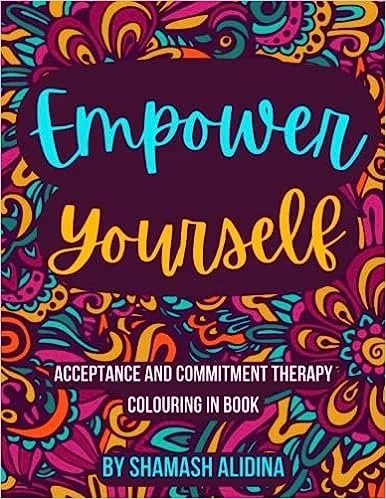
I’ve created a colouring-in book based on a longer list of ACT quotes. You can buy Empower Yourself here.
If you click on that link above, you can see the full list of quotes in the book in the book description.
Some links in this post go to Amazon. If you buy through one, I may earn a small commission at no extra cost to you. I only ever link to books and things I've actually read or use.